Geography 5, Lab 1C
Introduction to Monoculture
Monoculture is the agricultural practice of cultivating only one crop over a large area. This agricultural method developed in response to economic pressures; it represented a step away from subsistence agriculture to commercial agriculture. Monoculture began in the United States during the Colonial Era in response to global demand for tobacco; within the past century, the new agricultural method has expanded enormously due to increasing demands of the international market for crops of specific sizes, shapes, and nutritional value (“Monoculture”). Monoculture enables farmers to grow one specific crop in enormous quantity; it takes advantage of local weather and environment that are adaptable to specific crops. While monoculture is an efficient way of producing an impressive amount of crops in high demand, this method poses many problems to the environment. Not only has monoculture caused plants to become vulnerable to pests and disease, but it has also resulted in hazardous destruction of environmental biodiversity and has become associated with harmful practices such as clear-cutting. Current efforts aim to alleviate these problems by creating sustainable agricultural methods that produce essential crops while eliminating hazardous reductions in biodiversity.

California's Central Valley
California’s Central Valley is an expansive temperate grassland composed of two valleys: the Sacramento Valley in the north and the San Joaquin valley in the south. At 450 miles long and approximately 50 miles wide, the region provides a vast amount of space for the growth of crops; in fact the Central Valley produces about one third of all produce in the United States! Characterized by long warm summers, fertile soil, and improved irrigation systems, the Central Valley provides an ideal landscape for crop growth. Within the past century, farmers have resorted to monoculture methods to efficiently produce large-scale amounts of crops such as lettuce, grapes, citrus, and almonds.
California’s Central Valley is an expansive temperate grassland composed of two valleys: the Sacramento Valley in the north and the San Joaquin valley in the south. At 450 miles long and approximately 50 miles wide, the region provides a vast amount of space for the growth of crops; in fact the Central Valley produces about one third of all produce in the United States! Characterized by long warm summers, fertile soil, and improved irrigation systems, the Central Valley provides an ideal landscape for crop growth. Within the past century, farmers have resorted to monoculture methods to efficiently produce large-scale amounts of crops such as lettuce, grapes, citrus, and almonds.

However, the clearing of lands in order to grow one specific crop has lead to the destruction of ecosystems. Natural habitats once supporting the livelihood of mammals, birds, and insects have been entirely eliminated in some areas of the Central Valley, leading to a significant decrease in their population and threats of extinction in some cases (“The Environmental Food Crisis”). Honeybees are especially threatened by Central Valley’s monoculture; in areas dominated by a single crop, bees have been left to starve because nectar in these areas is only available for a few weeks each year (“Battling Mono”) Moreover, many of the mammals who once thrived in this area, characterized by grazing and burrowing adaptations, have all but disappeared. For example, the Tule Elk and Pronghorn, who once thrived in this region have decreased significantly over the years due to a replacement of their natural habitat with crop growth (“Ch. 10 The Great Central Valley”).
Land clearing for crop growth has also led to significant soil erosion and salt build-up in the soil (Ch. 10 The Great Central Valley), causing the destruction of the naturally occurring, temperate grassland biome that had dominated the area for so long. Today, only 1% of the region is covered by native grasslands; the other 99% of the region has been used for agriculture and industry (Ch. 10 The Great Central Valley). One reason for this reduction of native grassland is the extreme use of groundwater to support crops over the past century which has led to the drying of springs and wetlands that once supported a lush, temperate environment (“Ch. 10 The Great Central Valley”). Hence, desertification has begun to occur in this region; the overuse of water to support crops on a large-scale has resulted in a reduction in grassland and biodiversity (“Ch. 10 The Great Central Valley”)., the use of pesticides and insecticides to protect crops from harmful insects, has led to a buildup of dieldrin, which causes an increase in leech water, harming animals, insects, grasses, and crops (“Ch. 10 The Great Central Valley”). Hence, the once lush grasses of the Central Valley have begun to disappear and will continue to diminish if monoculture practices continue.
The Temperate Grassland Conservation Initiative (TGCI) is an environmental activist group that works to conserve existing grasslands. They hope to find alternative solutions to agricultural practices that threaten this biome. Protection of this biome would lead to increased biodiversity in this region and would protect animals’ natural habitats ("Global Protected Areas Program"). Activists have had limited success in this region as monoculture continues to rise in prominence.
General History of Monoculture
 |
| A 700+ year old farming system in China |
Monoculture can be dated back to the Bible, in which Leviticus 19:19 prohibits planting more than one kind of crop on the same field. Also, ancient farmers from the Fertile Crescent, which is a region in the Middle East, to China have always tried to utilize monoculture (Savage, "Monoculture, A Misused Term?"). Although the origin is difficult to locate in the Central Valley, in the United States, monoculture was prevalent as early as the colonial period in the production of tobacco, specifically in the South. This arose from failed family farms or due to industrialization and technological innovation in farming (Hurt, American Agriculture).
Science Behind Monoculture
The biggest problems behind monoculture are soil exhaustion and pest infestation. Monoculture heavily depends on chemicals like fertilizers and pesticides. The fertilizers are used because annually growing the same plant in the same field consistently rapidly depletes the nutrients that the plant relies on. Because these nutrients have to be replenished but unfortunately are not, monoculture “leads to decreased agricultural production and contributes to soil erosion” (Ivey, “Monoculture”). The pesticides are necessary because the fields for monoculture highly attract weeds and insect pests. Also, the fertilizers and pesticides farmers use to fight the consequences of soil depletion and pest infestations further results in water and air pollution as the toxic substances are filtered into the water supply or become airborne.
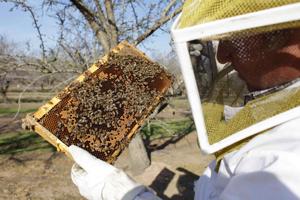 |
| An image depicting of both the almonds and the bees in the Central Valley. |


Global Consequences
 As stated before, bee “colony collapse disorder” in the Central Valley
has serious global consequences. Many crops in the Central Valley rely heavily on bee pollination, particularly the almond tree. The Central Valley consists of 1,400 square miles of almond trees, which produce three-fourths of the world’s supply of almonds (Marcotty, “Nature’s Dying Migrant Worker”). Each blossom on the almond trees requires pollination by at least one honeybee (Marcotty, “Nature’s Dying Migrant Worker”). If bees keep dying at this alarming rate, the world’s supply of almonds and other crops will suffer. Without pollination, almond tree production will shrink from more than 250 pounds to just 40 (d’Souza, “Let Us Now Praise Backyard Agriculture”).

Due to their heavy reliance on fossil fuels, monocultures also contribute to climate change that impacts every citizen worldwide. Machines require large inputs of energy in order to harvest, sort, pack, and transport monoculture crops. It takes an estimated ten calories of fossil-fuel energy in order to produce one calorie of food energy (“6 Problems with Monoculture Farming”).
In terms of social consequences, monocultures contribute to many global issues. Unfortunately, the lower prices of monoculture products often benefit urban populations but do not have the same impact in rural areas (“Monocultures Towards Sustainability”). This contributes to rural poverty, which is a significant global issue. Monocultures also have global dietary consequences for the poor. As poor populations consume more cheap monoculture crops such as maize, rice, and wheat and fewer fruits and vegetables, it increases their risk of micronutrient malnutrition due to decreased dietary diversity (“Monocultures Towards Sustainability”). This phenomenon is often referred to as the “hidden hunger,” and impacts many people worldwide.
Solutions
One of the solutions to this problem is to replace monoculture methods with intercropping. Intercropping is a practice that involves growing multiple crops at the same time in the same field. Intercropping is more sustainable than monoculture because it adds diversity to the cropping system. Intercropping prevents the spread of disease, thus reducing pesticide use and other chemical treatments. In a field experiment conducted in Northwest China from 2009 until 2012 that compared monoculture and intercropping systems, scientists found that “intercropping enhanced productivity and maintained the majority of soil fertility properties for at least three to four years” (Bao et al, “Intercropping Enhances Productivity”). There are several other sustainable alternatives to monoculture. One solution is to combine livestock with crop growth; livestock provide the soil with essential nutrients and “interrupts” harmful effects from insects and pesticides (“Agroecology in Action”). Incorporating pasture with crop growth results in the reduction of agrochemicals and helps to maintain soil fertility. Another alternative is crop rotation, which involves growing various types of crops consecutively in the same field. This reduces the necessity of chemical fertilizers and insecticides because it replenishes soil nutrients and disrupts the food supplies of pests (“Expanding Monoculture”). Other options for fertilizer and herbicide reduction are cover crops and natural pest predators such as birds and beneficial insects and spiders (“Expanding Monoculture”).
There aren't any organizations specific to the monoculture in the Central Valley, but the U.S. Department of Agriculture (USDA) have always discouraged monoculture to support soil fertility. As monoculture has been constantly and deeply researched, the practice has started to be seen as detrimental to balanced ecosystems, and policy makers as well as agriculturists have been more strongly against monoculture. Despite everything, the potential costs of diverting form one commercial crop stimulated resistance among growers in the US, specifically those in economically challenging states. Today, the USDA continues to advocate conserving arable soil by encouraging crop diversity (Ivey, "Monoculture").

This graph shows progress towards alternative forms of agriculture such as polyculture, which involves the growth of multiple crops. It indicates that yields of fish and shrimp from polyculture were greater than yields from monoculture in 2012 and 2013 and have increased within the two year margin. As previously explained, the growing of multiple crops is beneficial for ecosystems.

This graph indicates that profits from polyculture outdid profits from monoculture in 2012 and 2013. It shows that polyculture has increased total return within a two-year margin.
Conclusion
The likelihood for the problem of monoculture to improve is not very high in the Central Valley. Year after year are there higher temperature, reduced water supplies, and damage from the fertilizers and pesticides that are fatal to the crops. If more people (a lot more people) don’t start recognizing and acknowledging the effects of the practice of the Central Valley and taking the next step to fight the causes of the problem, the monoculture problem won’t ever be resolved, and prices of many foods, especially the almond, will jump intensely. Therefore, we must try to inform people of the dangers of monoculture and its harmful consequences on the environment. It is essential for farmers and scientists to work together to find sustainable methods of agriculture so that they may protect ecosystems and promote human health. Only when we adopt these new methods will we begin to see an increase in water quality, soil quality, plant life, and animal populations.
-------------------------------------------------------------------------------------------------------------------------------------
Works Cited
1. Altieri, A. Miguel. “Agroecology in Action.” Modern Agriculture. 30, June 2000. Web. 23 Nov. 2015.
http://nature.berkeley.edu/~miguel-alt/modern_agriculture.html
http://nature.berkeley.edu/~miguel-alt/modern_agriculture.html
2. Bao, Xing-Guo, Christie, Peter, Jin, Xin, Li, Long, Li, Xiao-Fei, Sun, Jian-Hao, Wang, Zhi-Gang and Jian-
Hua Zhao. “Intercropping Enhances Productivity and Maintains the Most Soil Fertility Properties
Relative to Sole Cropping.” Public Library of Science, Dec. 8 2014. Web. 17 Nov. 2015.
http://www.plosone.org
Hua Zhao. “Intercropping Enhances Productivity and Maintains the Most Soil Fertility Properties
Relative to Sole Cropping.” Public Library of Science, Dec. 8 2014. Web. 17 Nov. 2015.
http://www.plosone.org
3. Bee Shortage Threatens Central Valley Almond Output. Digital Image. N.d. Web. 17 Nov. 2015.
4. Bland, Alastair. “Battling Mono.” Metroactive. 2010. Web. 16 Nov. 2015.
http://www.metroactive.com/bohemian/08.03.11/feature-1131.html
5. Blevins, Naida; Koppel, Miriam; Rease, Tammy; Shrum, Amber. “Ch. 10: The Great Central Valley.”
Sonoma. 24 Nov. 2002. Web. 19 Nov. 2015.
http://www.sonoma.edu/users/c/cannon/bio314chapter10.html.
Sonoma. 24 Nov. 2002. Web. 19 Nov. 2015.
http://www.sonoma.edu/users/c/cannon/bio314chapter10.html.
6. “Central Valley.” State of California Department of Justice Office of the Attorney General. Harris D.
Kamala. Web 2015. 23, Nov. 2015. https://oag.ca.gov/gambling/game/central_valley
7. Crown Bees: The Gentle Bee Company. Web. 2014. 23, Nov. 2015. http://www.crownbees.com/bee-basics-
crownbees/our-pollination-challenge/the-almond-industry-is-the-perfect-storm-of-pollination/
crownbees/our-pollination-challenge/the-almond-industry-is-the-perfect-storm-of-pollination/
8. d’Souza, Gladwyn. “Let Us Now Praise Backyard Agriculture.” The Sierra Club. July/August 2012.
Web. 17 Nov. 2015. http://lomaprieta.sierraclub.org/
9. “Expanding Monoculture: 8 Ways Monsanto Fails at Sustainable Agriculture.” Union of Concerned
Scientists. n.d. Web. 17 Nov. 2015. http://www.ucsusa.org/
10. “Global Protected Areas Program.” IUCN. 6, Sept. 2014. Web. 24 Nov. 2015.
https://www.iucn.org/about/work/programmes/gpap_home/gpap_biodiversity/gpap_wcpabiodiv/gp
ap_grasslands/
https://www.iucn.org/about/work/programmes/gpap_home/gpap_biodiversity/gpap_wcpabiodiv/gp
ap_grasslands/
11. Henein, Maryam. "How California Almonds Are Killing Bees" HoneyColony. HoneyColony, Inc., 19 May
2014. Web. 17 Nov. 2015.
2014. Web. 17 Nov. 2015.
12. Hurt, R. Douglas. American Agriculture: A Brief History. Ames: Iowa State University Press, 1994.
13. ILEIA. “Monocultures Towards Sustainability.” Agricultures Network. LEISA Magazine, Dec. 2000. Web.
17 Nov. 2015.
17 Nov. 2015.
14. Ives, Mike. “The Rise of Rubber Takes Toll on Forests of Southwest China.” Yale Environment 360. Yale,
1 Aug. 2013. Web. 17 Nov. 2015. https://www.openpermaculture.com
1 Aug. 2013. Web. 17 Nov. 2015. https://www.openpermaculture.com
15. Ivey, Linda L. "Monoculture." In Brosnan, Kathleen A. Encyclopedia of American Environmental
History. 2010. Web. 17 Nov.2015. http://www.fofweb.com/History/MainPrintPage.asp?
iPin=EAEH0475&DataType=AmericanHistory
iPin=EAEH0475&DataType=AmericanHistory
16. McLennan, William. “Special Report: Environmental Damage and Human Rights Abuses Blight Global Tea
Sector.” The Ecologist, 13 Apr. 2011. Web. 17 Nov. 2015.
Sector.” The Ecologist, 13 Apr. 2011. Web. 17 Nov. 2015.
17. Savage, Steve. "Monoculture: A Misused Term?" Sustainablog. N.p., 10 Mar. 2011. Web. 17 Nov. 2015.
18. "The Problem with Pesticides." The Problem with Pesticides. N.p., n.d. Web. 17 Nov. 2015.
19. Silverstein, Jeff. Productive, Profitable, Resilient, Agriculture and Aquaculture systems. 13, June. 2013.
Web. 23, Nov 2015. http://www.slideshare.net/CPWF/g2-productive-profitable-resilient-agriculture-
aquaculture-systems-35830772
Web. 23, Nov 2015. http://www.slideshare.net/CPWF/g2-productive-profitable-resilient-agriculture-
aquaculture-systems-35830772
20. Wilson, E.O. “Why We Need Bees: Nature’s Tiny Workers Put Food on Our Tables.” Natural
Resources Defense Council. n.d. Web. 17 Nov. 2015. https://www.nrdc.org
21. “6 Problems with Monoculture Farming.” Open Permaculture School. n.d. Web. 17 Nov. 2015.
https://www.openpermaculture.com

No comments:
Post a Comment